Mohawk Central.
Valley story · Immigration & neighborhoods

Everyone came through Utica

Welsh printers, Irish canal diggers, German brewers, Italian bakers, Polish millhands, Lebanese peddlers — and, in our own time, refugees from Bosnia to Burma. Utica has always been a city people arrive in.

Utica · New Hartford · New York Mills · Whitesboro · 1800s–present · 2 min read · Last fact-checked Jul 17, 2026
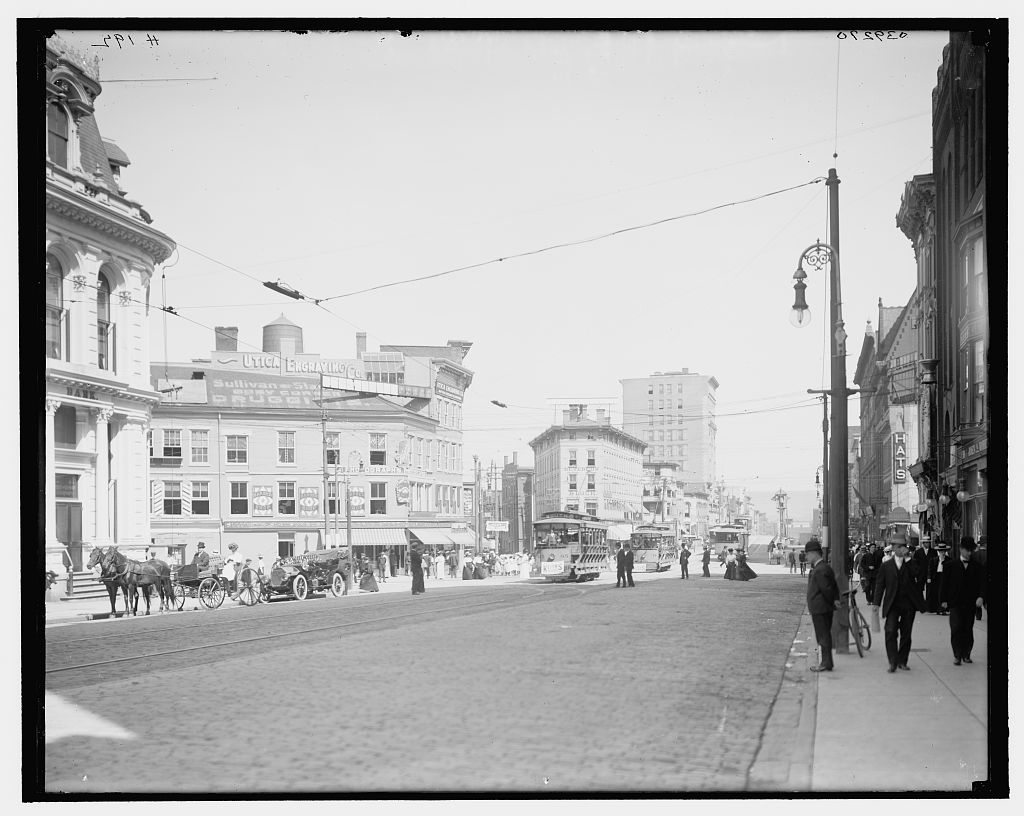
A busy downtown intersection around 1900 with streetcars, horse-drawn wagons, an early automobile and crowds of pedestrians in front of brick commercial buildings.
Genesee and Bleecker Streets around 1900 — the crossroads of a city where a dozen languages did business daily. (ca. 1900)Detroit Publishing Co. — Library of Congress, Prints & Photographs Division · No known restrictions on publication. View original ↗

The nineteenth-century layers

New England Yankees platted the town, but the canal filled it. Irish laborers who dug the Erie stayed to work it.1 Welsh families made the Utica area the publishing center of Welsh America — the national Welsh newspaper Y Drych was published here for a full century, from 1861 to 1960.23 Germans built breweries and churches; by the 1880s, Italian immigrants were turning East Utica into the neighborhood that still flavors the whole city (see Food with a history), while Polish families concentrated in West Utica's mill blocks, and Lebanese and Syrian newcomers — peddlers first, grocers soon after — built one of upstate's notable Arab-American communities.5

Each group's institutions — parishes, clubs, bakeries, funeral homes — mapped the city. Plenty of them are still on the same corners.

The refugee city

When the mills left, the pattern held. A resettlement agency established in Utica in 1979 — today simply The Center — began bringing refugees to a city with cheap housing and empty pews:4 Vietnamese and Soviet families, then more than 4,500 Bosnians in the 1990s, then Karen and other Burmese communities, Somalis, Sudanese, Congolese, and more. In 2008 the Bosnian community bought a shuttered Methodist church on Court Street from the city and spent four years turning it into a mosque — steeple, minaret and all.5

In 2005 the UN refugee agency's magazine put Utica on its cover as "the town that loves refugees,"6 and by the late 2010s national reporting was putting refugees and their children at roughly a quarter of the city's population — credited by local officials with stemming decades of decline.7 The exact share is an estimate; the effect on the streets, schools and storefronts is not.

Timeline

Sources & further reading

Numbers match the citations in the text
  1. History of Utica, NY ↗ — Landmarks Society of Greater Utica
  2. Welsh Imprints of Central New York (Eugene Paul Nassar) ↗ — Ethnic Heritage Studies Center, Utica College, 1998
  3. The Press in the United States of America (Y Drych) ↗ — National Library of Wales
  4. About The Center ↗ — The Center (formerly Mohawk Valley Resource Center for Refugees)
  5. How Utica Became a City Where Refugees Came to Rebuild (from Susan Hartman, City of Refugees) ↗ — Literary Hub / Beacon Press, 2022
  6. Refugees Magazine Issue 138: The Town That Loves Refugees ↗ — UNHCR, 2005
  7. What Happened When This Struggling City Opened Its Arms to Refugees ↗ — PBS NewsHour, July 6, 2017
  8. Oneida County History Center ↗ — Oneida County History Center

Related stories

Spot a mistake, or have material that adds to this story? Tell us. Last fact-checked Jul 17, 2026 · All history ↑