
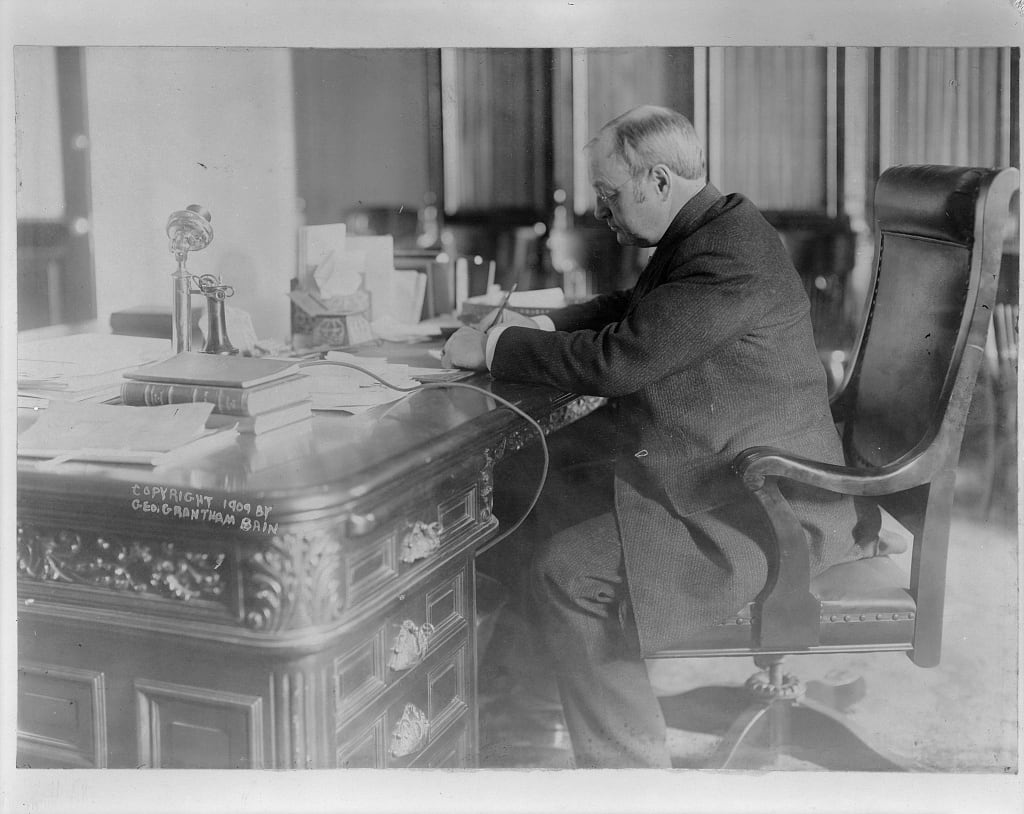
A lawyer, a bank, and city hall
Sherman was born in Utica on October 24, 1855, went down the road to Hamilton College in Clinton and graduated in 1878, studied law, and was admitted to the bar in 1880 to practice in his home city. He went on to run two local concerns as president — the Utica Trust & Deposit Co. and the New Hartford Canning Co.1
In 1884, at twenty-nine, Utica elected him mayor. Two years after that the district sent him to Congress, and he took his seat on March 4, 1887.1
Twenty years in the House
His run was not unbroken. Sherman served the Fiftieth and Fifty-first Congresses, lost his bid for re-election in 1890, and came back on March 4, 1893 — then stayed for eight consecutive Congresses, through March 3, 1909.1
From the Fifty-fourth Congress through the Sixtieth he chaired the Committee on Indian Affairs, fourteen years in the chair.1 Colleagues called him “Sunny Jim.” The Senate’s curator also records the name Native American leaders used for him — “Father Wau-be-ka-chuck,” or Four Eyes, for his spectacles.2
Vice president, and then not
Nominated for vice president on the ticket with William Howard Taft in 1908, Sherman was elected and served from March 4, 1909.1 In 1910 the sculptor Bessie Potter Vonnoh modeled him from life; the marble she carved from it reached the Capitol in December 1911 and went on view in the Senate’s main corridor.2
He was renominated in June 1912.1 He did not make it to the vote. Sherman died at his home in Utica at 9:50 in the evening on October 30, 1912; Taft issued the proclamation of his death the next day, closing the executive offices for the funeral and putting the flags at half-staff.3
The Republican ticket carried two states that November — Utah and Vermont, eight electoral votes. Before the electors met, Nicholas Murray Butler was picked to receive the eight that would have been Sherman’s.4 No vice president has died in office since.5
What is still here
In 1923 George Brewster’s statue of Sherman went up at the foot of Memorial Parkway, facing the Baron von Steuben statue across Genesee Street. Brewster also made the Thomas R. Proctor statue at the Parkway’s Elm Street intersection and the Alexander Hamilton at Hamilton College.6
He was buried at Forest Hill Cemetery on Oneida Street1 — the cemetery’s own list of residents puts him in a mausoleum there, a few turns from Governor Horatio Seymour.7
The house he died in we can’t point you to. We have not confirmed an address for it, or found a surviving, marked Sherman house in Utica, so this page doesn’t send you to one.