
Punched cards first
Ilion’s part in computing starts with the machines computers would replace. After a 1936 strike, Remington Rand moved production of its Powers punched-card accounting machines from Norwood, Ohio, into the old Library Bureau factory on Spruce Street.1 By 1952 the company ran three plants in the village: the original typewriter works; the Spruce Street building, Plant 2; and a long building on Main Street bought from Remington Arms in 1946, Plant 3. Plants 2 and 3 made punches, sorters, tabulators and interpreters, and the three plants together employed about 4,000 people.1
The computer that made the company famous came from somewhere else. UNIVAC I was designed and built by the Eckert-Mauchly company in Philadelphia,5 and the Census Bureau dedicated the first one there on June 14, 1951.2 The next spring Remington Rand announced that an office-size electronic computer, nicknamed the “baby brain,” would be made in Ilion and would add 1,200 jobs.1 The village’s centennial book, which reported it, doesn’t say which machine that turned out to be.
Made in Ilion
The Univac machine Ilion can claim with dates attached is the UNIVAC Solid State. It was designed at Remington Rand’s North Philadelphia plant, which built about ten for European customers. Building began in Ilion in January 1959. On May 20, 1960, the hundredth Solid State shipped, made by the Univac Division at Ilion.3
Ilion also trained the technicians who kept those machines running at customers’ offices. Hagley Library, which holds Sperry’s Univac photographs, has one from about 1959 of Univac employees installing a Solid State computer at the Ilion Computer School.4 A history of the company by Univac engineer Gerry Pickering says customer-engineer training and spare parts were handled in an old Ilion plant until the RCA deal. Sperry Rand took over RCA’s computer customers in January 1972, and with them came a training center in Princeton, New Jersey, where the training moved.5
The UNIVAC 1004, a plugboard-programmed card reader and printer, is harder to place. Its design work was done in Norwalk, Connecticut, with George Cogar as project engineer, and a member of that team recalls about 8,000 being built.6 A timeline drawn from the Herkimer County Historical Society’s 1992 county history says the first production 1004 came off the line in Ilion in 1963.7 The same engineer remembers manufacture in Utica. Both accounts are in the notes below.
Out of the Valley
Univac ran its Mohawk Valley work from Ilion and from a plant in Utica. A 1979 Utica Observer column said its people “worked in Ilion and in Utica from the 50s through the early 70s,” until Univac left the Valley. Many of them moved away, some to Bristol, Tennessee, some to Kentucky, others to California.8
The Spruce Street building was sold in 1972 to Donald J. Reiles, who leased it to a textile company owned by Duofold. Duofold owned the property itself from 1980 to 1986.13
A company in Herkimer
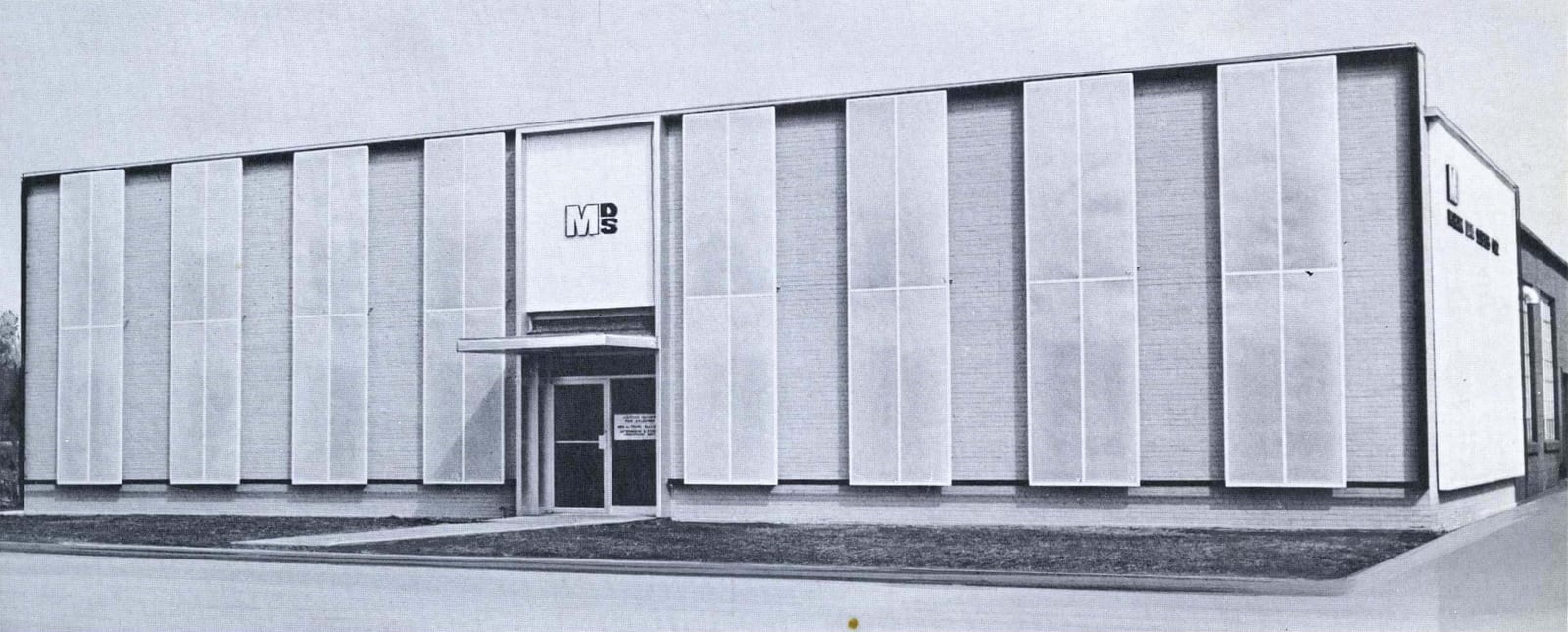
In August 1964 a group that had left what its investment bank called “the local Univac factory” started Mohawk Data Sciences in Herkimer. Eight founders put in $5,000 each, and A.G. Becker & Co. arranged $300,000 to build their first product. The bank’s history names Ed Johnson as the group’s leader and George Cogar as the product’s designer.9
That product was the 1101 Keyed Data-Recorder, made in Herkimer in 1965. An operator typed data straight onto magnetic tape. Before it, data was punched onto cards and a second machine copied the cards to tape. Within two years several thousand had been sold or rented, to users including insurers, banks, manufacturers and government offices, and the Smithsonian keeps one in its collection.10 The selling point was skipping the punched card, the card Ilion’s Remington Rand plants had been building machines for since 1936. At its height the MDS plant on Palisades Street, on Herkimer’s east side, employed roughly 1,300 people.11
A college in a computer plant
Herkimer County Community College started out in Univac space. In 1967 its trustees made Univac’s Plant #3 in Ilion the temporary campus, and the first classes were taught there.1214 The college’s own account calls Plant #3 an old factory building with “very few, if any, niceties and conveniences.”14
The permanent site came through MDS stock. A 100-acre site beside the Village of Herkimer was offered to the college at no cost, largely because of a gift of 4,000 shares of Mohawk Data Sciences stock, worth $136,000, from Edward Johnson, George Cogar, Richard Rifenburgh and Theodore Robinson. MDS also made the first major contribution to the college’s scholarship fund, two full-tuition scholarships.12
Spruce Street now
The Spruce Street building still stands, though not all of it. It was put up around 1907 to 1910 for the Library Bureau and Clark & Baker, furniture makers, and its main block is an L-shaped, four-story factory of about 124,000 square feet. It has been empty since 2001, and the Village of Ilion took it by foreclosure in 2019. High winds in the July 16, 2024 storm wrecked one end of the L, and the village’s contractor collapsed that section into its foundation.13
By June 2026 the state had accepted the site into its Brownfield Cleanup Program, and the village said it would close the sale to the Syracuse developer Lahinch Group. Conceptual plans keep the four-story main building and take down the rest.15